



Why Permanent Magnets Are Essential to Modern Technology
Why Permanent Magnets Are Essential to Modern Technology
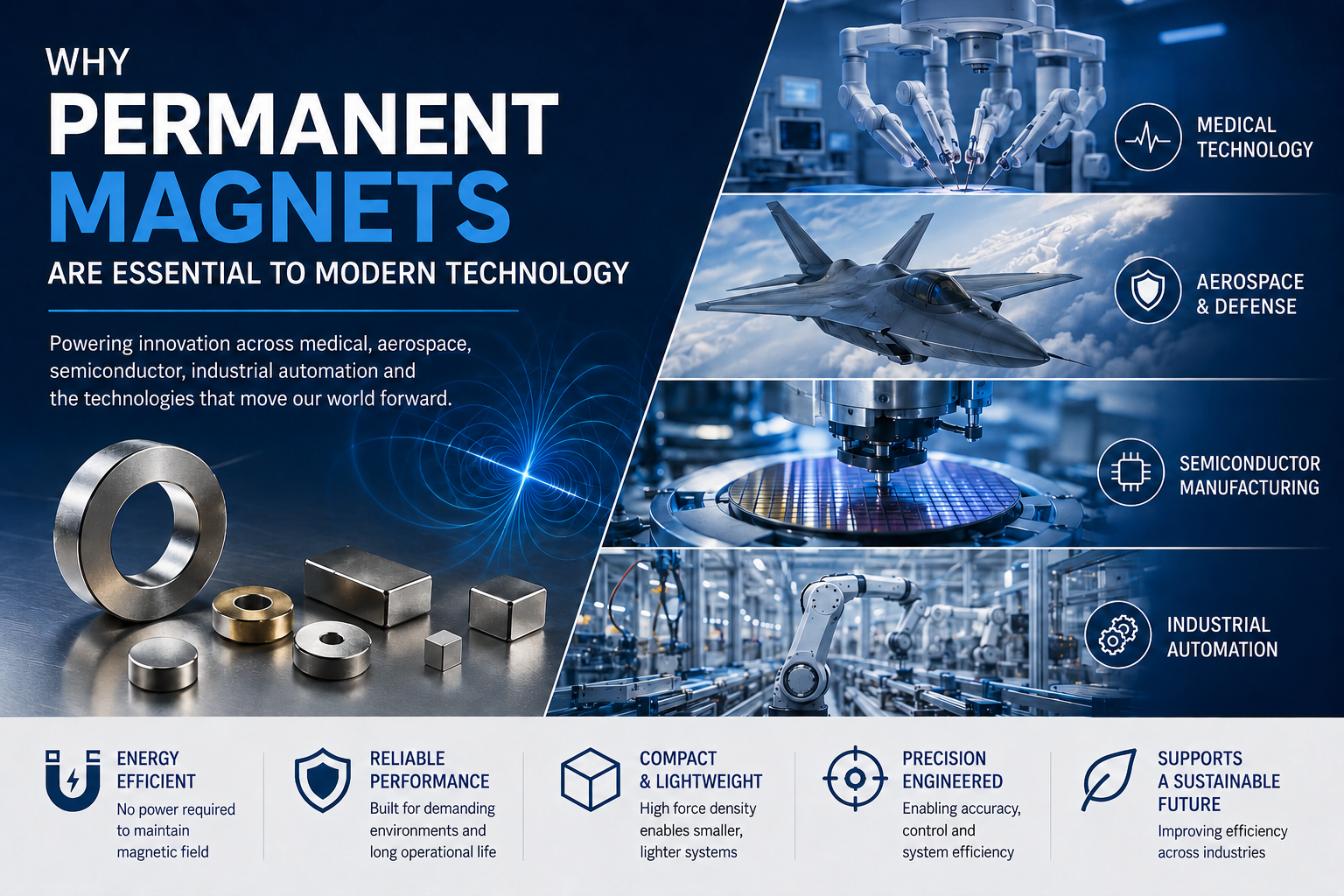
Permanent magnets are one of the most important enabling technologies in the modern world. While they often operate behind the scenes, they support many of the systems people rely on every day, from advanced medical equipment and aerospace platforms to semiconductor manufacturing tools and industrial automation systems.
As industries continue pushing for greater efficiency, miniaturization, precision, and reliability, permanent magnets have become increasingly critical to modern engineering.
Why Permanent Magnets Matter
Unlike electromagnets, permanent magnets create a continuous magnetic field without requiring external power. This allows them to deliver reliable performance while reducing energy consumption, system complexity, and maintenance requirements.
Their advantages include: 
- High force density in compact spaces
- Long operational life
- Reliable performance in demanding environments
- Efficient operation without continuous electrical input
- Support for miniaturized and lightweight designs
High-performance materials such as Neodymium Iron Boron (NdFeB) and Samarium Cobalt (SmCo) allow engineers to tailor magnetic performance to specific environmental and operational requirements.
As systems become smaller and more complex, engineered magnetic assemblies help maintain performance without increasing size or weight.
Supporting Advanced Medical Technology
Permanent magnets play a major role in modern medical technologies where precision and reliability are essential.
Applications include:
- Robotic surgical systems
- MRI and imaging equipment
- Diagnostic and laboratory instruments
- Drug delivery systems
- Precision sensing and positioning assemblies
In robotic-assisted surgery, magnets support highly controlled movement and positioning that help surgeons perform minimally invasive procedures with greater accuracy. In imaging systems, stable magnetic fields are critical for producing high-quality diagnostic results.
Medical environments also create unique engineering challenges. Magnetic components may require corrosion-resistant coatings, biocompatible materials, and cleanroom-compatible designs to ensure long-term reliability and patient safety.
As healthcare technologies continue advancing, the demand for compact, high-performance magnetic solutions will continue to grow.
Enabling Aerospace and Defense Performance
Aerospace and defense systems operate in some of the harshest environments imaginable. Components must withstand extreme temperatures, vibration, pressure changes, and long operational lifecycles without sacrificing reliability.
Permanent magnets support critical applications including:
- Guidance and navigation systems
- Actuation systems
- Radar and communication systems
- Sensors and control assemblies
Samarium Cobalt magnets are especially valuable in aerospace applications because they maintain magnetic stability at elevated temperatures and in demanding operating environments.
Magnetic assemblies also help reduce overall system weight while maintaining high performance, which is essential for aircraft, satellites, and next-generation defense platforms.
As electrification and advanced sensing technologies continue expanding across aerospace systems, permanent magnets remain a foundational technology.
Driving Precision in Semiconductor Manufacturing
The semiconductor industry depends on extraordinary levels of precision and repeatability. Permanent magnets help enable the motion control and positioning systems required to manufacture advanced electronic devices.
Key applications include:
- Linear motor systems
- Wafer handling equipment
- Vacuum-compatible assemblies
- Alignment systems
- Sputtering and deposition equipment
These systems must operate with extremely tight tolerances while minimizing vibration and contamination. Engineered magnetic assemblies help improve positioning accuracy, throughput, and process consistency.
As semiconductor devices become more advanced and manufacturing tolerances continue shrinking, precision magnetic engineering becomes even more important to production success.
The Future of Magnetic Innovation
Permanent magnets continue to support innovation across nearly every advanced industry. As technologies evolve toward greater automation, electrification, and miniaturization, magnetic systems will remain essential to achieving higher performance and reliability.
From medical breakthroughs to aerospace advancements and semiconductor innovation, permanent magnets continue powering the technologies shaping the modern world.