



What Makes Magnets Fail?
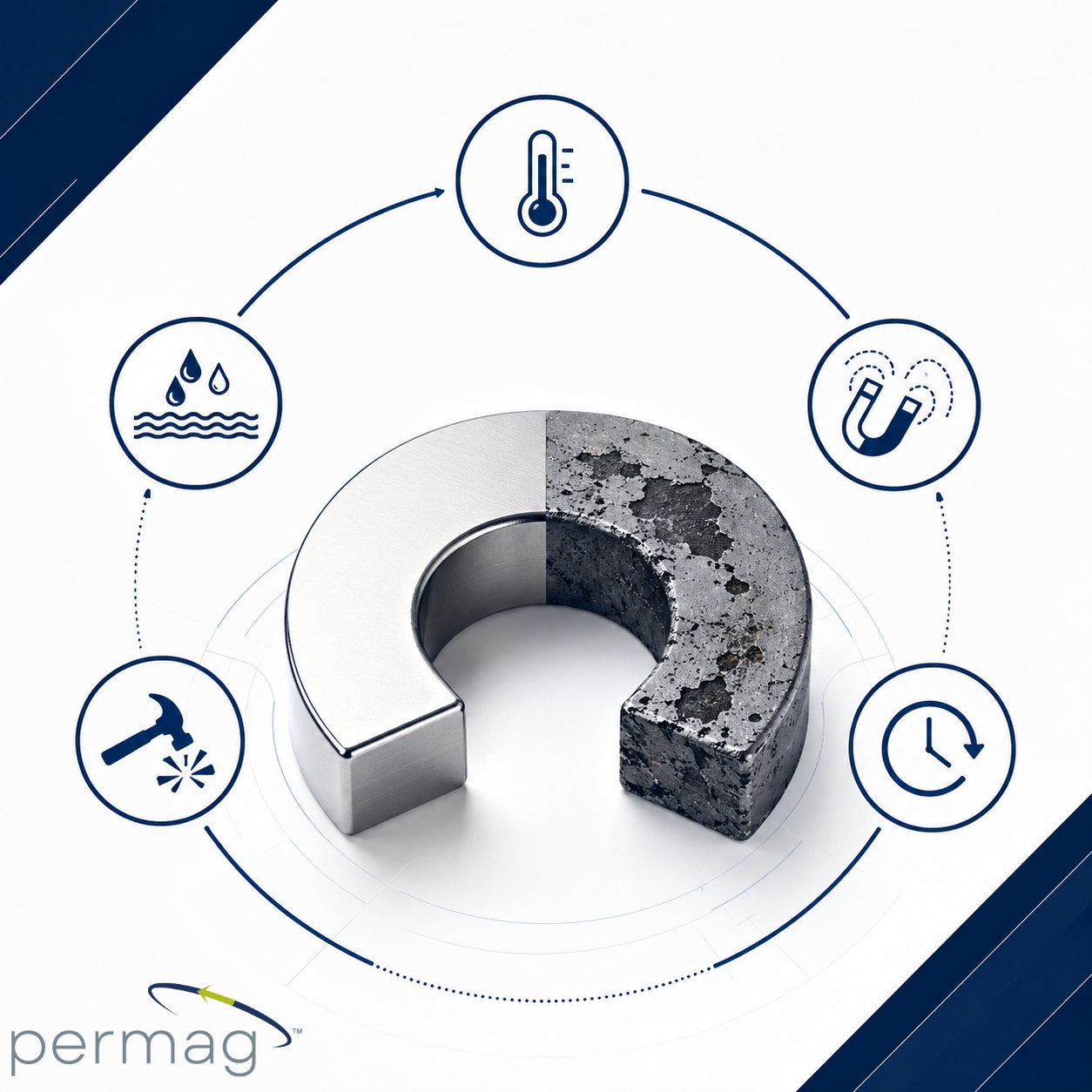
What Makes Magnets Fail?
Understanding why magnets fail and lose strength is critical for engineers designing systems that must perform reliably over time. From aerospace actuators to semiconductor equipment and medical devices, magnetic performance can directly impact precision, efficiency, and operational lifespan.
Permanent magnets are engineered to maintain stable magnetic fields for years, often decades. However, certain environmental and operational conditions can gradually weaken or even permanently damage a magnet. Understanding the causes of magnet degradation helps engineers select the right materials, coatings, and designs for demanding applications.
How Magnets Maintain Their Strength
Inside every permanent magnet are microscopic regions called magnetic domains. Each domain acts like a tiny magnet with its own north and south poles. When these domains align in the same direction, they combine to create a strong magnetic field.
When the domains become disrupted or lose alignment, magnetic performance begins to decline. In some cases, the loss is temporary. In others, the damage is permanent.
Several factors can contribute to this degradation.
Heat and Thermal Demagnetization 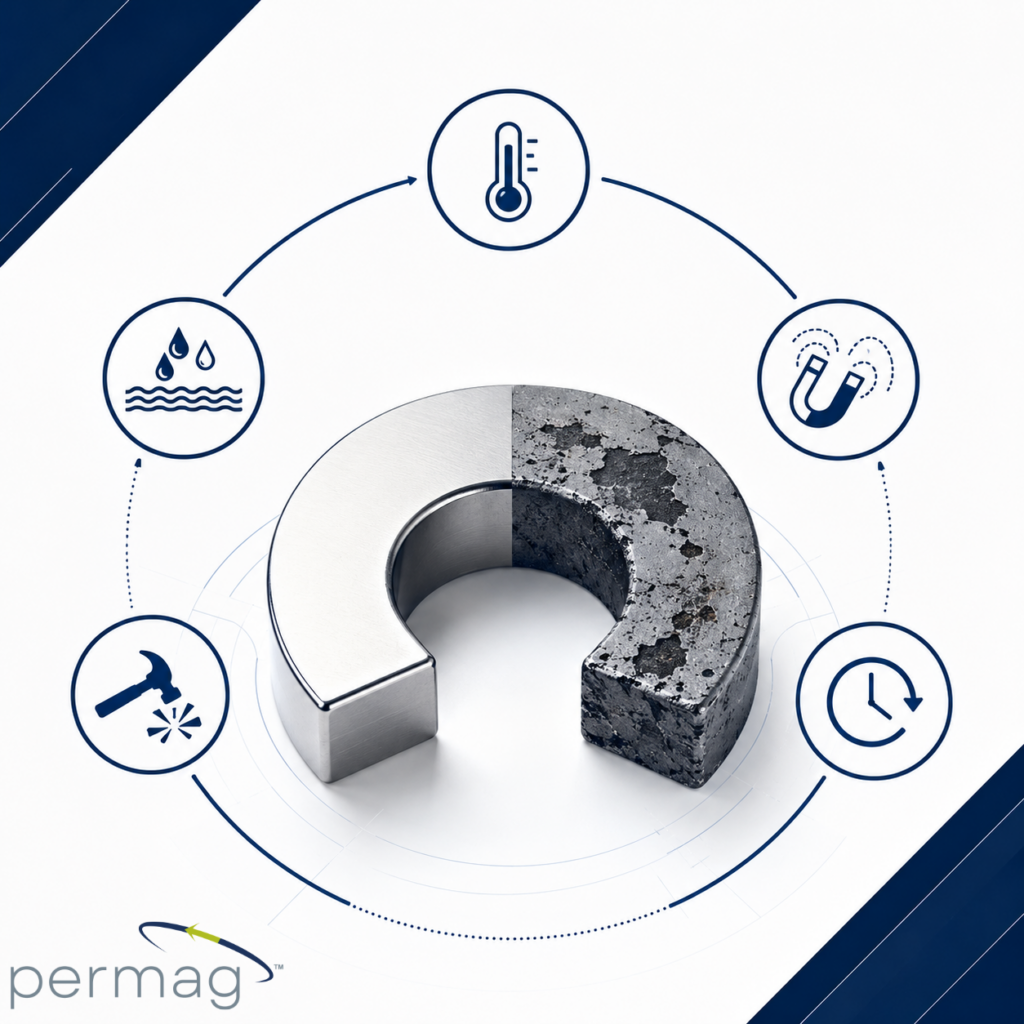
Temperature is one of the most common causes of magnetic weakening. As magnets are exposed to elevated temperatures, thermal energy causes increased atomic motion inside the material. This movement disrupts the alignment of the magnetic domains and reduces overall magnetic strength.
Every magnetic material has temperature limitations. If a magnet exceeds its maximum operating temperature, irreversible demagnetization can occur.
This is particularly important in applications such as:
- Motors and generators
- Semiconductor manufacturing equipment
- Industrial automation
- Downhole energy applications
Material selection plays a major role in thermal stability. Samarium cobalt (SmCo) magnets are often preferred in high-temperature environments because they maintain magnetic performance under extreme heat conditions. Neodymium iron boron (NdFeB) magnets offer higher magnetic strength but generally have lower temperature resistance unless specially engineered.
Corrosion and Environmental Exposure
Corrosion is another major contributor to magnet degradation, especially for neodymium-based materials. Exposure to moisture, humidity, chemicals, or corrosive gases can attack the magnet surface and compromise the material itself.
Over time, corrosion can:
- Reduce magnetic field strength
- Create surface cracking or flaking
- Cause dimensional instability
- Shorten operational lifespan
This is why coatings and encapsulation are often essential in harsh operating environments. Nickel plating, epoxy coatings, hermetic sealing, and specialty protective finishes can significantly improve durability and long-term reliability.
For critical aerospace, medical, defense, and semiconductor applications, corrosion resistance is often designed into the magnetic assembly from the start rather than added later as an afterthought.
External Magnetic Fields
Magnets can also lose strength when exposed to strong external magnetic fields, particularly fields oriented in the opposite direction of the magnet’s own field.
In these conditions, the external field can force magnetic domains to realign or randomize, weakening the magnet’s overall performance.
This risk becomes especially important in systems where multiple magnetic components operate in close proximity, including:
- Motors and actuators
- MRI and imaging systems
- Electronic warfare systems
- Precision sensing equipment
- High-performance robotics
Proper magnetic circuit design and shielding can help minimize unintended field interactions and preserve long-term performance.
Mechanical Shock and Physical Stress
Magnets are also vulnerable to mechanical damage. Severe impact, vibration, or sudden physical stress can disrupt domain alignment and reduce magnetic performance.
Some magnetic materials are naturally more brittle than others. Neodymium and samarium cobalt magnets, for example, provide exceptional magnetic strength but can fracture under excessive mechanical stress if not properly protected within an assembly.
Engineered mounting strategies, structural reinforcement, and protective housings help reduce the risk of damage in high-vibration or high-impact environments.
Aging and Long-Term Performance Loss
Even under normal operating conditions, magnets can experience gradual magnetic aging over time. Small changes caused by temperature fluctuations, environmental exposure, and repeated external field interactions may slowly alter domain alignment.
While most modern permanent magnets are designed for excellent long-term stability, understanding expected operating conditions is essential when designing systems intended for decades of reliable service.
Designing for Magnetic Reliability
Preventing magnet degradation starts with proper engineering. Material selection, thermal analysis, protective coatings, magnetic circuit optimization, and environmental testing all play important roles in ensuring reliable long-term performance.
At Permag, magnetic solutions are engineered specifically for demanding operating environments where performance stability matters most. From high-temperature aerospace systems to cleanroom-compatible semiconductor equipment and mission-critical defense applications, custom magnetic assemblies are designed to maintain strength, precision, and reliability throughout their operational lifespan.