



Understanding the Measurement of Magnetism
Magnetic fields are all around us, from the small magnets holding notes to a refrigerator to the powerful systems driving MRI machines, semiconductor manufacturing equipment, and advanced aerospace technologies. But how do engineers and scientists measure magnetism in a consistent and meaningful way?
Understanding magnetic field magnetic units is essential for comparing field strengths, selecting the right materials, and designing systems that perform reliably in real-world environments.
Why Magnetic Measurement Matters
Magnetic fields can vary dramatically in strength depending on the application. A simple consumer magnet produces only a small magnetic field, while industrial and scientific systems may generate fields thousands or even millions of times stronger.
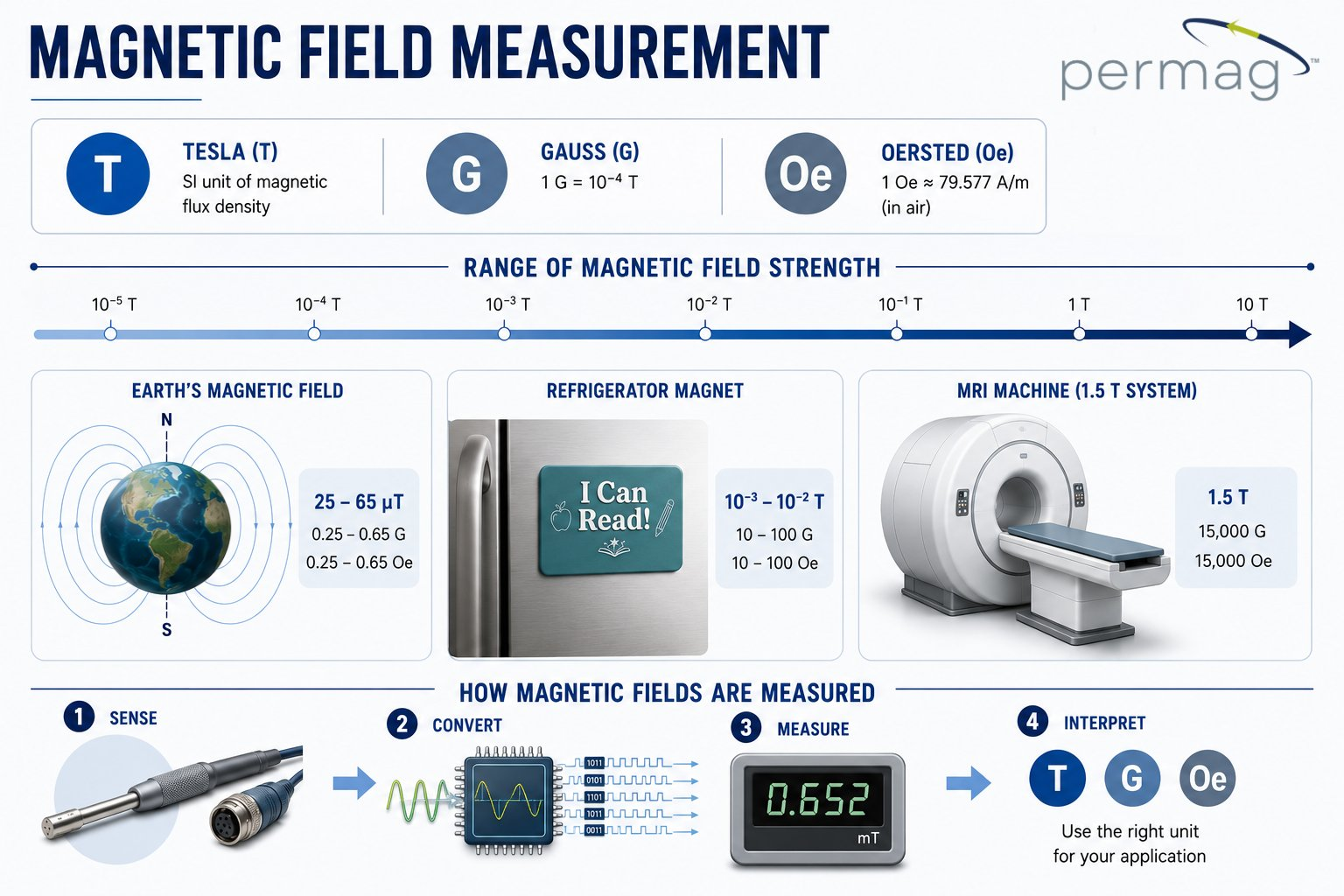
To accurately describe and engineer these systems, standardized units are used to measure magnetic field strength and magnetic flux density. The most common units engineers encounter include: 
- Tesla (T)
- Gauss (G)
- Oersted (Oe)
Historically, other units such as Maxwell (Mx) and Weber (Wb) have also been used in magnetic science and engineering.
Tesla: The Modern Standard
The tesla is the International System of Units (SI) measurement for magnetic field strength and is the standard unit used across most scientific and engineering applications today. The unit is named after Nikola Tesla, whose work helped shape the modern understanding of electromagnetism.
In practical terms, a tesla represents the force exerted on a current-carrying conductor within a magnetic field. While the physics behind the definition can become complex, the key takeaway is simple: tesla is typically used to describe moderate to very strong magnetic fields.
Some examples include:
- A standard hospital MRI system operates around 1.5 tesla
- High-performance industrial magnets may operate in multi-tesla ranges
- The strongest continuous magnetic fields produced in laboratory environments can exceed 45 tesla
In advanced industries such as aerospace, defense, semiconductor manufacturing, and medical technology, tesla measurements are critical for designing systems that require highly controlled magnetic performance.
Gauss: A Common Unit for Smaller Fields
The gauss is another widely recognized magnetic unit, named after mathematician and physicist Carl Friedrich Gauss. Unlike tesla, gauss is not an SI unit, but it remains common throughout magnetics, manufacturing, and industrial discussions.
Gauss is particularly useful when discussing smaller magnetic fields because the numbers are easier to work with in many practical applications.
The relationship between the two units is straightforward:
1 tesla = 10,000 gauss
For example:
- A strong refrigerator magnet is approximately 100 gauss
- That same field can also be expressed as 0.01 tesla
Engineers often move between tesla and gauss depending on the scale of the magnetic field they are evaluating.
Oersted and Other Historical Units
Another unit engineers may encounter is the oersted (Oe), which historically has been used to measure magnetic field intensity rather than magnetic flux density. While less common in modern SI-based engineering, oersted measurements still appear in some magnetic material specifications and legacy technical documentation.
Other historical units include:
- Maxwell (Mx) for magnetic flux
- Weber (Wb), the SI unit for magnetic flux
Although these units are less visible in everyday engineering discussions, they remain part of the broader foundation of magnetic science.
Putting Magnetic Fields Into Perspective
One of the easiest ways to understand magnetic measurement is by comparing familiar field strengths across different environments:
- Earth’s magnetic field: approximately 25 to 65 microteslas (µT)
- Refrigerator magnet: approximately 100 gauss
- Medical MRI system: approximately 1.5 tesla
- Advanced research magnets: up to 45 tesla
These comparisons help illustrate the enormous range of magnetic field strengths used across modern technologies.
Engineering Magnetics With Precision
Accurate magnetic measurement is more than a scientific exercise. It directly impacts system performance, reliability, efficiency, and safety.
Whether designing compact medical devices, high-temperature aerospace systems, semiconductor manufacturing equipment, or advanced defense technologies, engineers rely on precise magnetic characterization to ensure components perform exactly as intended.
At Permag, magnetic engineering starts with understanding how fields behave in real-world operating conditions. By combining material expertise, advanced modeling, and precision manufacturing, custom magnetic assemblies can be optimized for the specific field strengths and environments each application demands.