



Understanding Eddy Currents: What They Are and Why They Matter
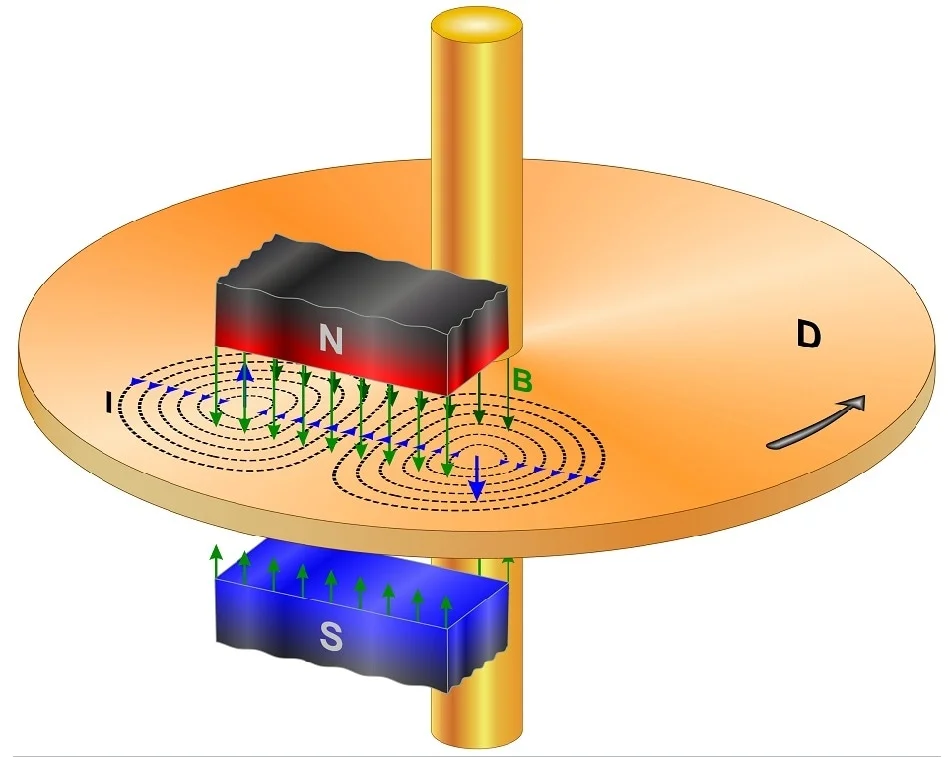
Eddy currents are a fundamental electromagnetic phenomenon that plays a critical role in modern engineering systems. From induction heating and braking systems to precision sensing and non-destructive testing, these currents can either be harnessed for performance or controlled to prevent efficiency losses.
For engineers designing high-performance magnetic assemblies, understanding eddy currents is essential for optimizing efficiency, thermal performance, and system reliability.
What Are Eddy Currents?
Eddy currents are circulating electrical currents induced within a conductive material when it is exposed to a changing magnetic field. These currents form closed loops and result from electromagnetic induction.
As the magnetic field changes, it drives electron motion within the conductor. The induced currents generate their own magnetic fields that oppose the original field change, a principle defined by Lenz’s Law. This interaction leads to energy dissipation, typically as heat, and the generation of forces that can be either beneficial or detrimental depending on the application.
What Causes Eddy Currents?
Eddy currents arise when magnetic flux changes within a conductor. This can occur in two primary ways.
First, exposure to a time-varying magnetic field induces currents as the material reacts to changes in field strength or direction. Second, relative motion between a conductor and a magnetic field can create the same effect, as the conductor experiences a changing magnetic environment.
Key Factors That Influence Eddy Currents
The behavior of eddy currents depends on several key design variables. Stronger magnetic fields induce higher current densities, increasing both force and heat generation. Material properties also play a critical role. Electrical conductivity affects how easily currents form, while magnetic permeability influences how the material interacts with the field.
Geometry further impacts performance. Larger conductive paths enable stronger circulating currents, while thickness and segmentation determine how currents distribute. Frequency is equally important, as higher frequencies increase the rate of magnetic flux change and can significantly amplify eddy current effects.
Where Eddy Currents Add Value
In many applications, eddy currents are intentionally used to improve performance. Induction heating leverages these currents to generate controlled, localized heat within conductive materials, making it valuable across industrial, medical, and consumer systems.
Eddy currents also enable non-contact braking. As a conductor moves through a magnetic field, resistive forces are generated without mechanical wear, supporting reliable braking in transportation and industrial equipment.
They are widely used in non-destructive testing, where induced currents help detect surface defects, corrosion, and material inconsistencies. In precision systems, eddy currents also provide magnetic damping, reducing vibration and improving stability.
When Eddy Currents Become a Challenge
Despite their benefits, eddy currents can negatively impact system performance if not properly managed. Resistive losses can generate unwanted heat, affecting material integrity and long-term reliability.
They also contribute to efficiency losses in motors, transformers, and other electromagnetic systems by dissipating energy that could otherwise perform useful work. In high-precision environments, uncontrolled eddy currents can distort magnetic fields and reduce sensing accuracy.
Engineering Strategies to Control Eddy Currents
Managing eddy currents requires a deliberate design approach. Lamination is commonly used to limit current loop size by dividing conductive materials into thin, insulated layers, reducing losses.
Material selection provides another control mechanism, as lower-conductivity materials can reduce current formation. Magnetic shielding helps contain field distribution and prevent unintended induction in surrounding components.
Geometric optimization is also critical. Designing components to interrupt current paths minimizes circulating currents and improves both efficiency and thermal performance.
Why Eddy Current Understanding Matters in Magnetic Design
In advanced applications across aerospace, defense, medical, and semiconductor markets, eddy currents directly influence system performance. Whether the goal is maximizing force density, minimizing losses, or ensuring precise control, these effects must be engineered intentionally.
At Permag, magnetic assemblies are designed with a deep understanding of electromagnetic behavior. By combining material expertise with application-specific engineering, eddy current effects can be controlled or leveraged to deliver optimized performance.