



Transcutaneous Magnetic Torque Transfer: Non-Invasive Power and Motion Control
Implantable medical devices continue to become more sophisticated, creating new challenges around how power and mechanical motion are transferred between external equipment and components inside the body. For cardiovascular and neurological applications, engineers must balance performance with reliability, compact size, and the need to protect the biological barrier.
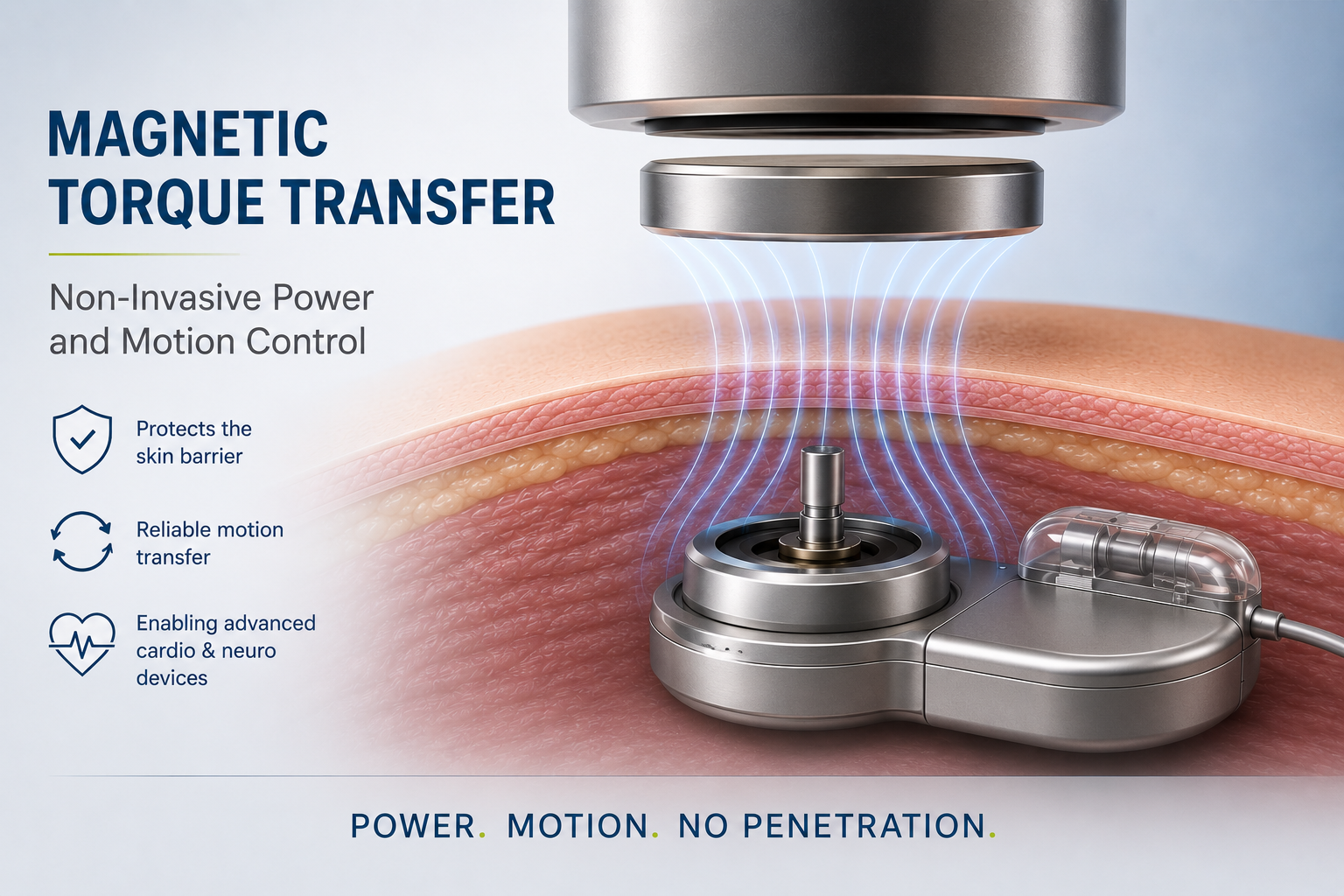
Transcutaneous magnetic torque transfer provides one solution. By using magnetic coupling to transmit rotational motion across intact tissue, these systems can deliver mechanical energy without requiring a physical shaft or mechanical connection through the skin. 
How Magnetic Torque Crosses the Skin Barrier
A transcutaneous magnetic torque transfer system typically consists of an external magnetic driver and an implanted magnetic rotor, coupling, or driven assembly. As the external component rotates, its magnetic field interacts with the implanted magnetic assembly. The resulting magnetic coupling causes the internal component to rotate without direct physical contact between the two systems.
The concept is similar to a conventional magnetic coupling, but the separation between the driving and driven components includes skin and other biological tissue.
This creates an important engineering challenge. Magnetic field strength decreases as the distance between components increases, making the coupling gap a critical design parameter.
Engineering for Efficient Torque Transfer
Generating sufficient torque across tissue requires careful optimization of the complete magnetic circuit. Magnet material, geometry, orientation, pole configuration, coupling distance, and rotational speed can all influence system performance.
High-energy permanent magnets such as neodymium iron boron (NdFeB) and samarium cobalt (SmCo) can provide high magnetic performance within compact geometries. Material selection depends on the application’s field requirements, available space, operating temperature, corrosion protection strategy, and other environmental conditions.
Engineers must also account for variations that may occur during actual use. Tissue thickness can differ between patients, and the relative position of external and implanted components may change with movement. Angular, axial, and lateral misalignment can reduce coupling efficiency or available torque.
For this reason, magnetic systems should be evaluated across their entire anticipated operating envelope rather than at a single ideal alignment.
Protecting the Biological Barrier
One of the primary advantages of transcutaneous magnetic torque transfer is the elimination of a mechanical drive shaft passing through the skin.
Percutaneous mechanical connections can introduce additional challenges involving sealing, infection pathways, tissue interaction, wear, and long-term reliability. Magnetic coupling allows the skin to remain intact while mechanical energy is transmitted to the implanted device.
The implanted magnetic assembly itself must still be engineered for the biological environment. Depending on the device, magnets may require corrosion-resistant coatings, encapsulation, or hermetic sealing to isolate magnetic materials from bodily fluids.
Applications in Cardio and Neuro Devices
Magnetic torque transfer can be considered for medical technologies that require externally driven mechanical movement inside the body. Potential applications include circulatory support systems, implantable pumps, ventricular assist technologies, adjustable implants, and specialized neurological devices.
Depending on system requirements, magnetic coupling may support continuous rotation, intermittent actuation, positioning, or adjustment.
Modeling the Magnetic Interface
Because performance depends on numerous interacting variables, magnetic modeling is an important part of system development. Finite element analysis can be used to evaluate magnetic field distribution, coupling strength, torque capability, and sensitivity to changes in alignment or separation distance.
Simulation also allows engineers to compare magnet materials, geometries, and pole configurations before committing to prototypes.
For transcutaneous systems, the objective is not simply to generate the strongest possible magnetic field. The goal is to achieve predictable torque transfer across realistic tissue distances and operating conditions while meeting the size, thermal, material, and reliability requirements of the medical device.
When these variables are considered together, magnetic coupling can provide an effective mechanical interface between external equipment and implanted technology without compromising the integrity of the skin barrier.