



The Role of Magnetic Technology in Miniaturization of Implantable Medical Devices
The Role of Magnetic Technology in Miniaturization of Implantable Medical Devices
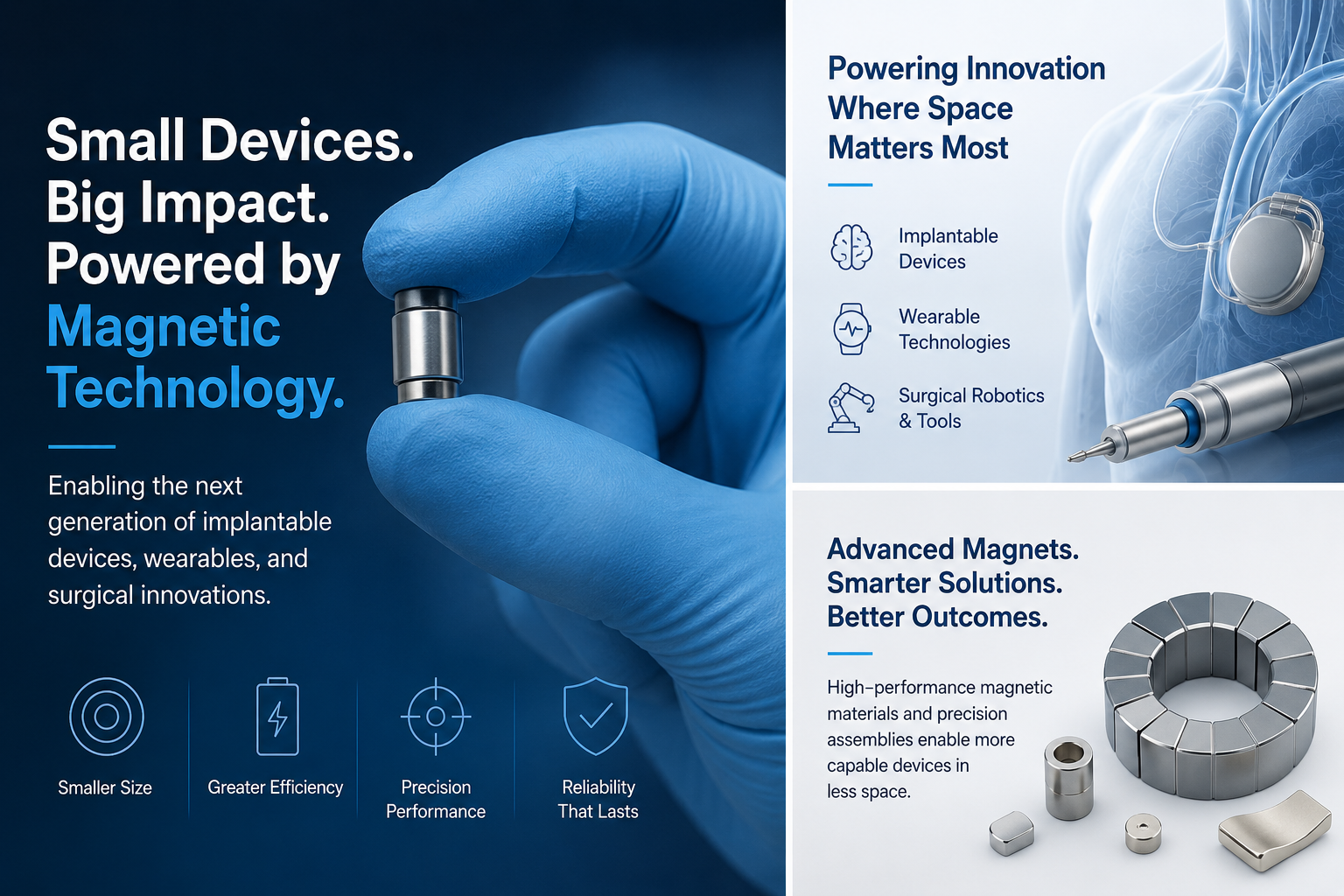
Medical technology continues to move toward smaller, smarter, and less invasive solutions. From implantable drug delivery systems to wearable monitors and robotic surgical instruments, device miniaturization is improving patient outcomes while expanding what clinicians can accomplish. Behind many of these advancements is magnetic technology, which enables engineers to pack more performance into increasingly compact designs.
Permanent magnets and precision magnetic assemblies allow medical device manufacturers to reduce size without compromising reliability, accuracy, or efficiency.
 Why Miniaturization Matters
Smaller medical devices provide meaningful benefits for both patients and healthcare providers. Implantable devices often require less invasive procedures, resulting in shorter recovery times, reduced tissue trauma, and improved patient comfort. Compact wearable devices also make continuous monitoring more practical, helping clinicians collect valuable data without disrupting daily life.
For manufacturers, miniaturization creates opportunities to develop new therapies and improve existing technologies. As devices shrink, every component must perform efficiently within a limited amount of space, making magnetic engineering more important than ever.
Magnetic Technology Makes Compact Designs Possible
High performance permanent magnets generate powerful magnetic fields from remarkably small packages. This allows engineers to design miniature motors, actuators, sensors, and positioning systems that fit inside implantable and handheld medical devices.
Material selection plays a critical role. Samarium cobalt magnets offer exceptional temperature stability, corrosion resistance, and long term magnetic performance, making them well suited for many implantable and surgical applications. Neodymium magnets provide extremely high magnetic strength where maximum power density is required and environmental conditions permit.
Beyond the magnet itself, precision magnetic assemblies ensure every component delivers consistent performance while occupying as little space as possible. Tight dimensional tolerances and carefully controlled magnetic properties help maintain accuracy in demanding medical environments.
Innovation Across Medical Applications
Miniaturized magnetic components are enabling innovation across a wide range of medical technologies.
- Implantable medical devices rely on compact magnetic systems for miniature motors, implantable pumps, neurostimulation devices, and precision sensing. These components help deliver reliable performance over many years while fitting within strict size constraints.
- Wearable medical technologies benefit from lightweight magnetic assemblies used in sensors, portable diagnostic equipment, and drug delivery systems. Efficient magnetic designs can also contribute to lower power consumption, helping extend battery life.
- Surgical robotics and high speed surgical tools depend on compact brushless motors, precision rotary assemblies, and magnetic couplings that deliver smooth, accurate motion. Smaller magnetic components allow robotic systems and surgical drills to become more ergonomic while maintaining the torque, speed, and precision required for delicate procedures.
Engineering Challenges Require Early Collaboration
Miniaturization is not simply about making parts smaller. Engineers must balance magnetic performance, thermal management, biocompatibility, corrosion resistance, manufacturing tolerances, and long term reliability.
Early collaboration between medical device designers and magnetic engineering experts helps identify the best material, optimize component geometry, and improve manufacturability before production begins. This approach reduces development risk while accelerating time to market.
The Future of Medical Device Innovation
As healthcare continues to embrace minimally invasive procedures and personalized therapies, demand for smaller, more capable medical devices will continue to grow. Advanced magnetic materials, precision manufacturing, and application specific engineering are helping make that future possible.
Whether powering implantable devices, wearable technologies, or next generation surgical robotics, magnetic technology remains a critical driver of medical innovation, enabling designers to deliver more performance in less space.