



Rare-Earth Magnets in Surgical Robotics
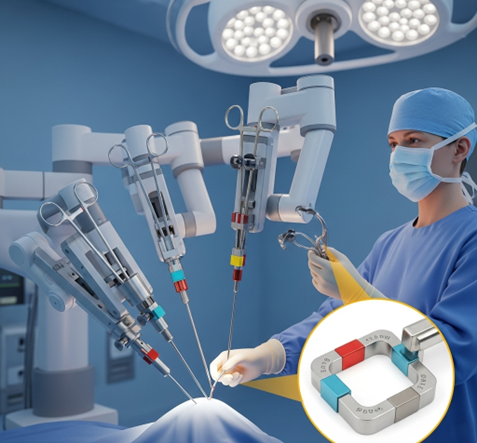
From steady wrist articulation to contactless torque transfer, the magic behind surgical robotics often starts with an invisible force—rare-earth magnetics.
As surgical robots evolve to become more compact, precise, and multifunctional, rare-earth magnets are enabling the next wave of innovation. But choosing the right magnetic materials—and designing them for surgical-grade performance—requires more than standard specs. This guide explores how rare-earth magnets power surgical robotics and how custom magnetic solutions from Permag give design engineers a true edge.
Why Rare-Earth Magnets Are the Heart of Surgical Robotics
Surgical robots perform delicate, high-precision tasks that demand compact actuation, real-time sensing, and reliable tool handling. Rare-earth magnets—especially Neodymium-Iron-Boron (NdFeB) and Samarium Cobalt (SmCo)—offer the magnetic performance needed to meet these demands, all within tight spatial and regulatory constraints.
Key Surgical Robotics Use Cases
- Actuation: High-torque micro motors with NdFeB rotors drive robotic joints with smooth, controlled motion.
- Sensing & Feedback: Magnetic encoders and Hall-effect sensors deliver real-time positional data to support haptics and closed-loop control.
- Couplings & Retention: Magnetic couplings transmit torque across sealed boundaries, while retention magnets enable secure, rapid tool changes.
- Damping & Protection: Eddy-current brakes and magnetic torque limiters protect delicate tissue from mechanical overreach.
These applications rely on magnets that are not only powerful, but also reliable in sterilization and safe in proximity to the human body.
Material Selection: NdFeB vs. SmCo
Both NdFeB and SmCo are staples in surgical robotics, but each has unique benefits—learn more here.
Magnetic Miniaturization for Precision Robotics
Surgical robotics thrives on miniaturization. Every extra millimeter matters—especially in wristed instruments, catheter-driven actuators, or compact end-effectors. Permag supports:
- Micro magnet machining for sub-millimeter geometries
- Halbach arrays to focus fields in tight volumes
- Insert molding and custom encapsulation for integrated components
- Cleanroom assembly (ISO 7) for Class II and Class III-ready devices
Explore Permag’s advanced capabilities in medical magnetics.
Biocompatibility & Sterilization: Engineering for the OR
Rare-earth magnets are powerful—but raw NdFeB is corrosive and brittle. Surgical systems demand surface treatments that hold up to:
- Autoclave cycles (up to 134°C)
- Gamma irradiation or EtO sterilization
- Repeated exposure to saline, blood, and cleaning agents
Coating Options Include:
- Parylene C — Thin, conformal, biocompatible (ISO 10993-1)
- Titanium or Gold — Noble metals with strong biostability
- BarrierMax™ — Engineered coatings optimized for magnet integrity and regulatory readiness
Customization: Why Off-the-Shelf Doesn’t Cut It
The surgical robotics field moves fast—and design teams can’t wait for custom magnet specs to align late in development. Permag helps OEMs get ahead by:
- Offering rapid prototyping
- Running 3D magnetic field simulations (FEA) to optimize field orientation
- Delivering turnkey assemblies including magnets, housings, sensors, and rotor components
- Managing material traceability and ISO 13485 documentation