



Plasma Power: How Magnetics Shape PVD and Etch Performance
Plasma Power: How Magnetics Shape PVD and Etch Performance
As semiconductor devices continue to shrink while performance expectations grow, manufacturing processes must achieve exceptional precision and repeatability. Physical Vapor Deposition (PVD) and plasma etch systems are essential to producing today’s advanced semiconductors, but their success depends on one critical factor: stable, well controlled plasma.
Behind that control is an often-overlooked technology. Carefully engineered magnetic assemblies help shape plasma behavior, improving process stability, film uniformity, and overall equipment performance.
 Controlling Plasma Where It Matters Most
Plasma is created by ionizing process gases inside a vacuum chamber. In both PVD and plasma etch systems, the density, stability, and distribution of that plasma directly influence deposition rates, etch uniformity, and process repeatability.
Without proper control, manufacturers can experience inconsistent film thickness, uneven etch profiles, excessive target wear, and lower production yields. As feature sizes continue to decrease, even minor variations become increasingly significant.
Magnetic field engineering provides an effective way to manage these challenges by controlling how charged particles move within the process chamber.
How Magnetic Fields Improve Plasma Performance
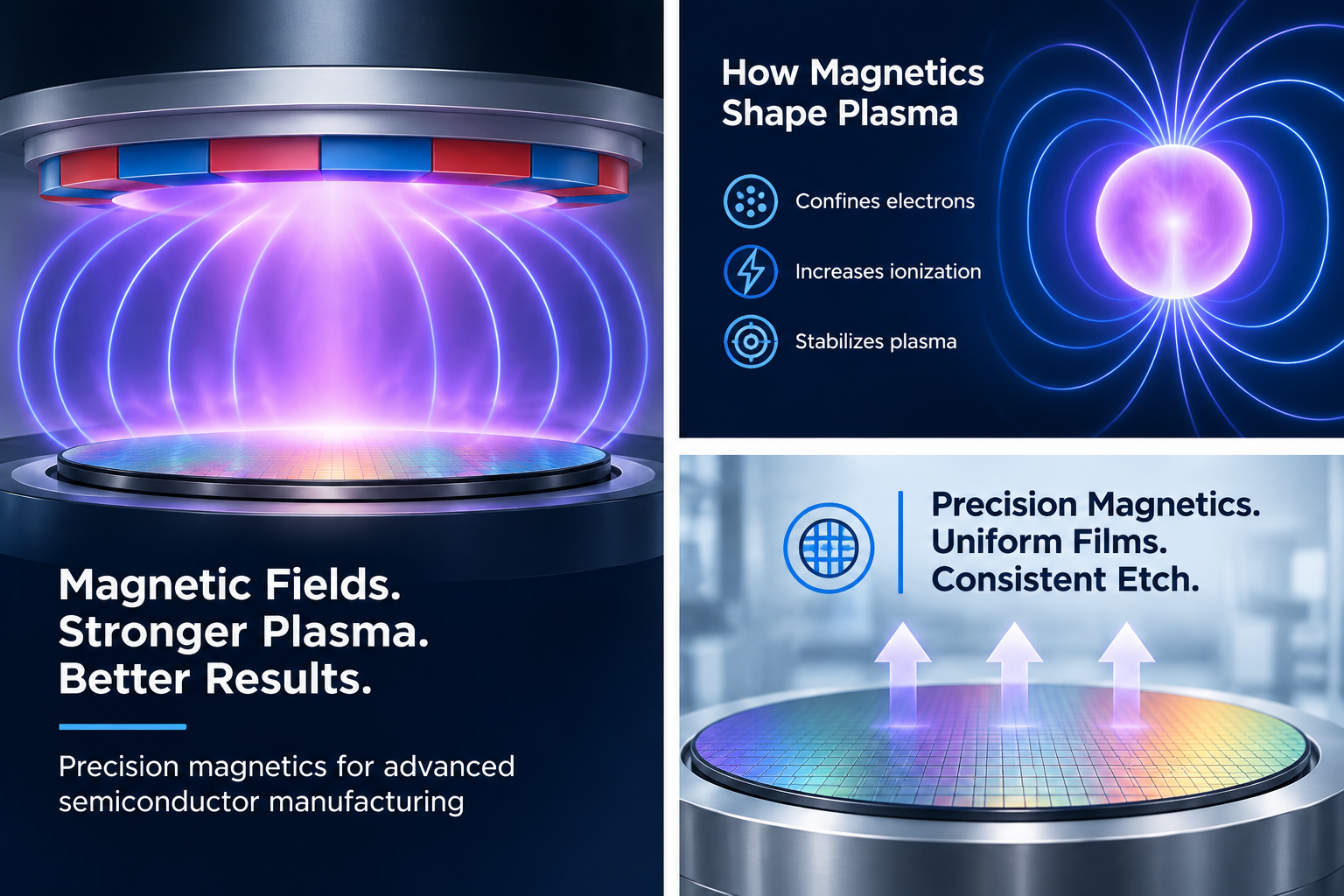
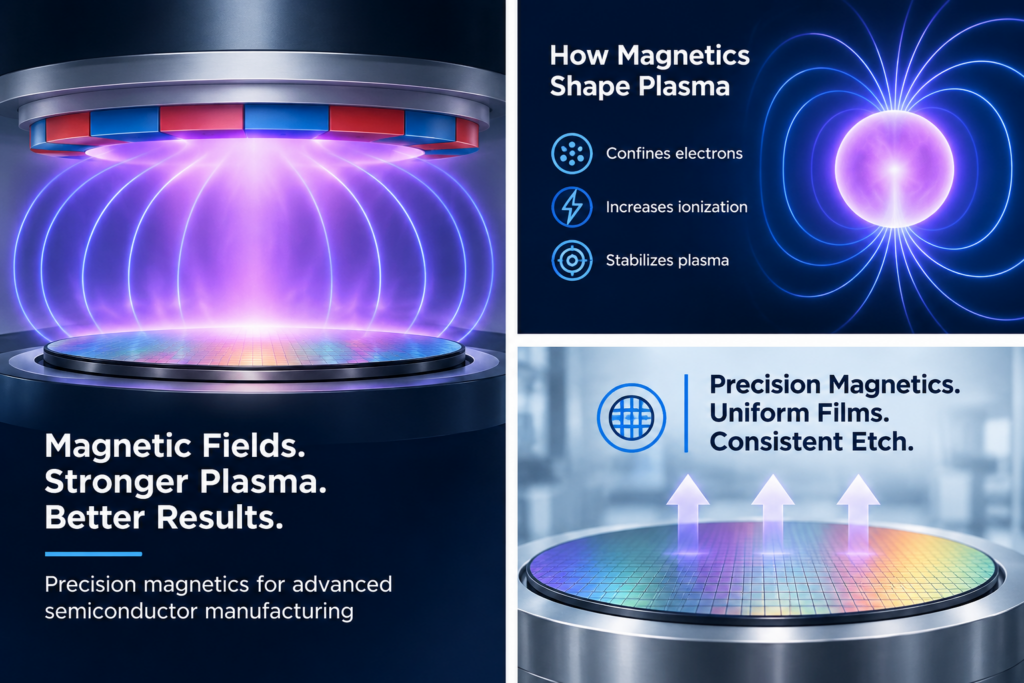
Permanent magnets are strategically arranged to generate magnetic fields that confine electrons near the target or process region. By increasing electron confinement, the system promotes more efficient ionization while maintaining a stable plasma.
This improved confinement provides several important advantages:
- Higher plasma density
- Improved process efficiency
- Lower operating pressures
- More consistent plasma stability
- Reduced variability in target erosion during PVD
Rather than simply generating a magnetic field, engineers carefully design the field geometry to match the specific process requirements of each application.
Improving Uniformity Across the Wafer
Uniformity is one of the most important performance metrics in semiconductor manufacturing. Magnetic field distribution plays a direct role in maintaining consistent plasma density across the wafer surface.
In PVD systems, optimized magnetic circuits help produce more uniform thin film deposition, resulting in tighter thickness control and improved coating consistency.
For plasma etch applications, precise magnetic control contributes to:
- More uniform etch rates
- Improved critical dimension control
- Reduced edge effects
- Greater process repeatability from wafer to wafer
These improvements support the production of advanced logic devices, memory technologies, power semiconductors, and compound semiconductor devices where process consistency is essential.
Engineering Magnetics for Semiconductor Equipment
Every semiconductor tool has unique process requirements, making custom magnetic design a critical part of equipment development. Engineers must balance field strength, magnetic distribution, temperature stability, mechanical tolerances, and long term reliability.
By collaborating early in the equipment design process, magnetic specialists can optimize assemblies for manufacturability while supporting demanding process performance goals.
As semiconductor technologies continue to evolve, precision magnetic engineering will remain a key enabler of stable plasma processes and consistent manufacturing results.
At Permag, our engineering team works with semiconductor equipment manufacturers to develop custom magnetic assemblies that help improve plasma control, enhance process consistency, and support the next generation of semiconductor innovation.