



Magnetic Systems for Harsh Environments and Shock Loads
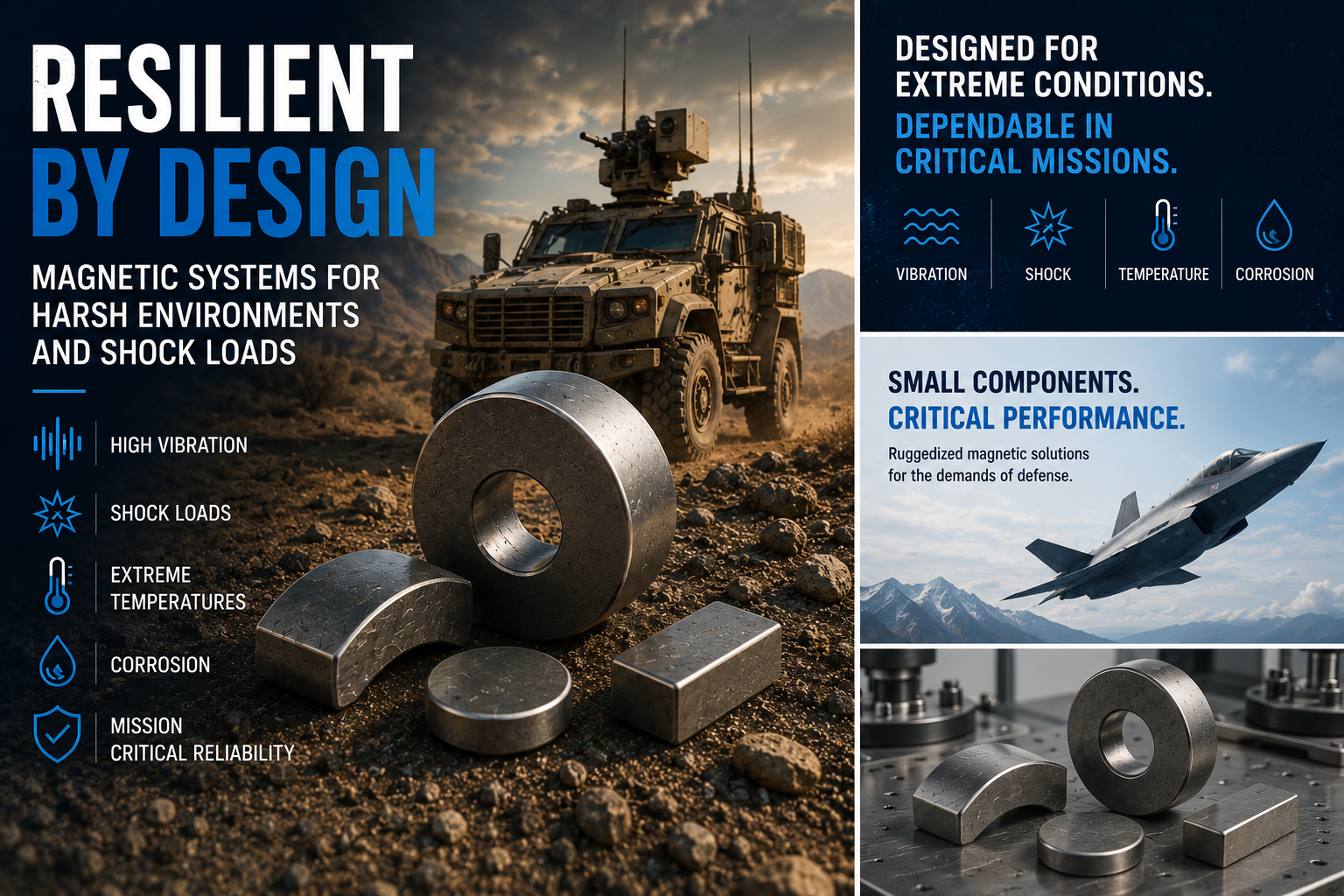
Resilient by Design: Magnetic Systems for Harsh Environments and Shock Loads
Defense systems are expected to perform reliably in conditions that push materials and components to their limits. From aircraft and missile systems to radar, guidance, actuators, and other mission-critical platforms, magnetic components may be exposed to extreme temperatures, severe vibration, mechanical shock, and demanding environmental conditions.
Designing for these applications requires more than selecting a magnet with sufficient magnetic strength. Reliability begins with understanding the complete operating environment and engineering the magnetic system to withstand it.
Understanding the Environment
 Magnetic components in defense applications rarely face a single environmental challenge. An assembly may experience continuous vibration during operation, a sudden high-g shock event during launch or deployment, and significant temperature changes throughout the mission.
Temperature can influence magnetic output and the performance of adhesives, coatings, housings, and other assembly materials. Moisture, salt spray, chemicals, and contaminants may introduce additional concerns, particularly when corrosion-sensitive materials are involved.
These conditions must be considered together because the magnetic system ultimately needs to perform as an integrated assembly.
Selecting the Right Magnetic Material
Material selection is one of the first decisions in designing a ruggedized magnetic system. Maximum magnetic strength is only one consideration.
Samarium cobalt (SmCo) is frequently selected for demanding aerospace and defense applications because of its high-temperature capability, magnetic stability, and inherent corrosion resistance. Neodymium iron boron (NdFeB) can also provide excellent performance when the operating temperature, environmental exposure, protective coatings, and overall system design are appropriate.
Engineers must also consider resistance to demagnetization and how magnetic properties change across the application’s specified temperature range. Selecting the right material requires balancing magnetic performance with the realities of the operating environment.
Designing for Shock and Vibration
Permanent magnets can be mechanically brittle, making assembly design particularly important in systems exposed to shock and vibration.
Mechanical retention features, specialized adhesives, encapsulation, protective housings, and carefully engineered magnet geometries can help distribute loads and protect magnetic components. Designers must also account for differences in thermal expansion between magnets and surrounding materials, particularly when assemblies experience repeated thermal cycling.
Modeling and simulation can help engineers evaluate magnetic performance and identify potential mechanical or thermal concerns before a design reaches production. Addressing these risks early can reduce the likelihood of costly redesigns later in the development process.
Validating Performance Before Deployment
For mission-critical defense applications, a design must perform reliably outside of controlled laboratory conditions. Validation may include shock and vibration testing, thermal cycling, dimensional inspection, environmental exposure testing, and verification of magnetic performance before and after testing.
The specific validation process depends on the application, but the objective remains the same: confirm that the magnetic system can maintain predictable, repeatable performance throughout its intended operating environment and service life.
Resilience Starts with Engineering
Rugged magnetic systems are not created by a single material choice or protective feature. They result from the combination of material science, magnetic engineering, mechanical design, precision manufacturing, and thorough validation.
By considering shock, vibration, temperature, and environmental exposure from the earliest stages of development, engineers can design magnetic systems that are prepared for the demanding conditions defense platforms encounter.
Permag works with defense customers from concept through production to evaluate magnetic materials, optimize magnetic and mechanical designs, address manufacturability, and develop reliable solutions for demanding environments.