



Magnetic Levitation: How Magnetics Keep High-Speed Trains Moving
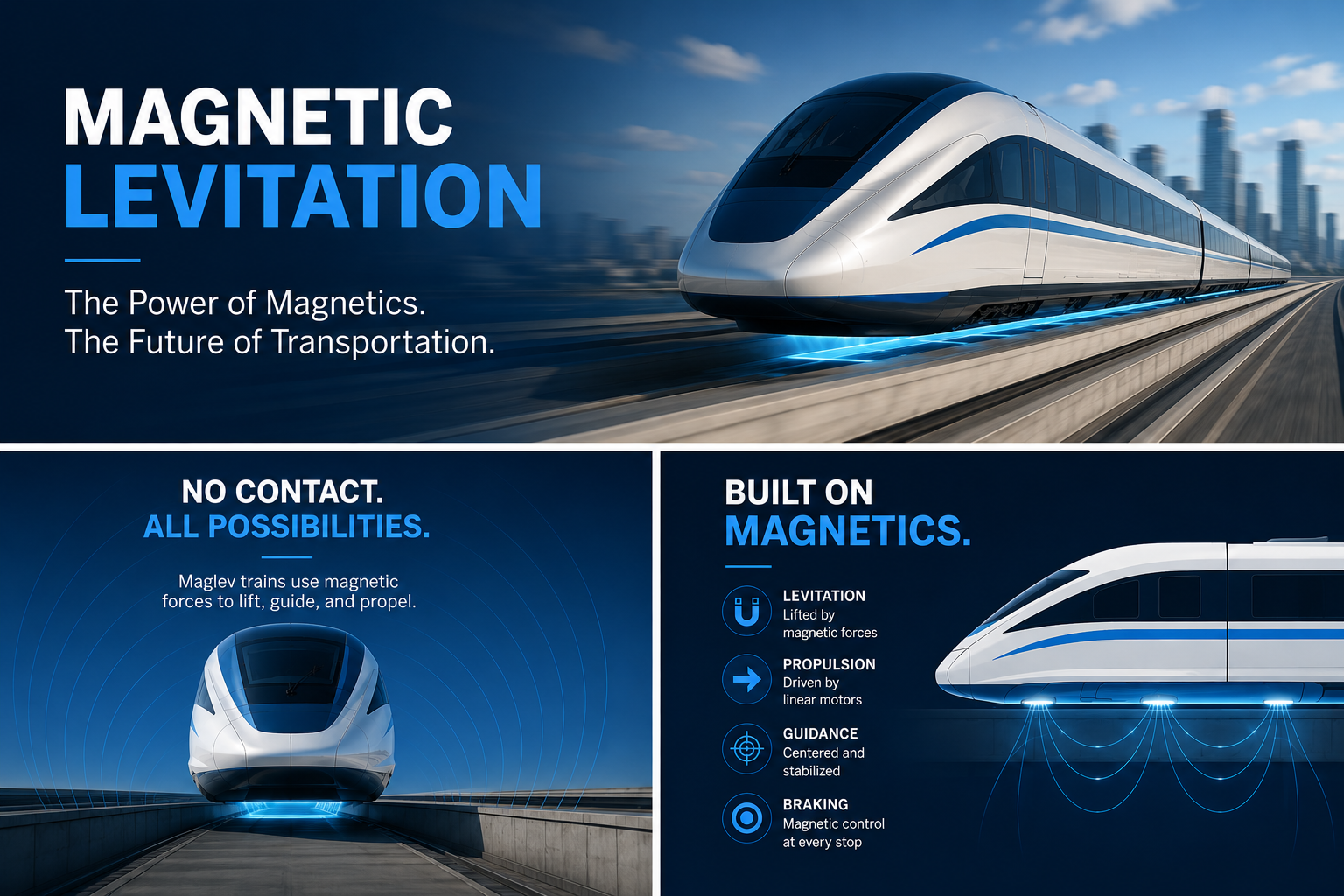
At speeds exceeding 300 miles per hour, magnetic levitation trains demonstrate what is possible when magnetic forces replace traditional mechanical contact.
Commonly known as Maglev trains, these systems use magnetics for nearly every aspect of operation, including levitation, guidance, propulsion, stability, and braking. Instead of wheels continuously contacting rails, carefully controlled magnetic fields allow the train to travel above a guideway with minimal mechanical resistance.
While the concept may seem futuristic, the principles behind Maglev transportation have been developing for more than a century.
From Early Concepts to High-Speed Transportation
 The origins of magnetic levitation transportation date back to the early 1900s. In 1912, French-American inventor Émile Bachelet received a U.S. patent for a “Levitating Transmitting Apparatus,” which used electromagnets to levitate a cart above a track. Bachelet envisioned the technology for transporting packages, mail, passengers, and freight.
Those early concepts helped establish the foundation for today’s Maglev systems, where advanced magnetic technologies enable trains to operate without continuous physical contact between the vehicle and guideway.
Using Magnetic Fields to Levitate and Guide
Unlike conventional rail systems, Maglev trains do not depend on wheel-to-rail contact during normal high-speed operation. Magnetic forces between the train’s undercarriage and the guideway provide the lift needed to suspend the vehicle while additional magnetic forces keep it centered and stable.
Two primary technologies are used to achieve this levitation: electromagnetic suspension (EMS) and electrodynamic suspension (EDS).
Electromagnetic Suspension (EMS) uses attractive forces between electromagnets and the guideway to lift the train. One advantage of EMS is its ability to maintain levitation while the train is stationary. Because the system requires precise control of the air gap between the train and guideway, sophisticated feedback and control systems continuously adjust the magnetic forces to maintain stability.
Electrodynamic Suspension (EDS) instead relies on repulsive magnetic forces, typically generated using superconducting magnets. These systems can produce powerful magnetic fields capable of providing both lift and stability. However, superconducting magnets require cryogenic cooling, adding complexity to the overall system. EDS trains also typically require forward motion before sufficient levitation force is generated, making wheels necessary at lower speeds.
Propulsion Without a Conventional Motor
Magnetics do more than keep a Maglev train suspended. They also move it forward.
Maglev systems use linear motors, which apply the principles of a conventional electric motor along a straight path. Rather than using a rotating rotor and stator, electromagnetic coils positioned along the guideway generate a traveling magnetic field.
By precisely controlling the sequence and polarity of these magnetic fields, the system creates linear force that pulls and pushes the train along the guideway. The same principles can also contribute to braking, with magnetic forces applied in opposition to the train’s direction of travel.
Why Magnetic Levitation Matters
Eliminating continuous mechanical contact provides several important advantages. Maglev trains can reach speeds above 300 mph while providing a smoother and quieter ride than many conventional rail systems. Reduced mechanical friction can also decrease wear on components and minimize some of the maintenance associated with traditional wheel-and-rail systems.
At very high speeds, aerodynamic drag becomes one of the primary forces limiting performance. Concepts incorporating reduced-pressure or vacuum environments could further decrease resistance and expand the potential of magnetic transportation.
Maglev trains provide a compelling example of magnetic engineering at scale. From generating lift and maintaining precise positioning to producing propulsion and controlled braking, magnetic systems make it possible to transform a century-old concept into high-speed transportation technology.