



Magnetic Assemblies in Satellite Control and Positioning
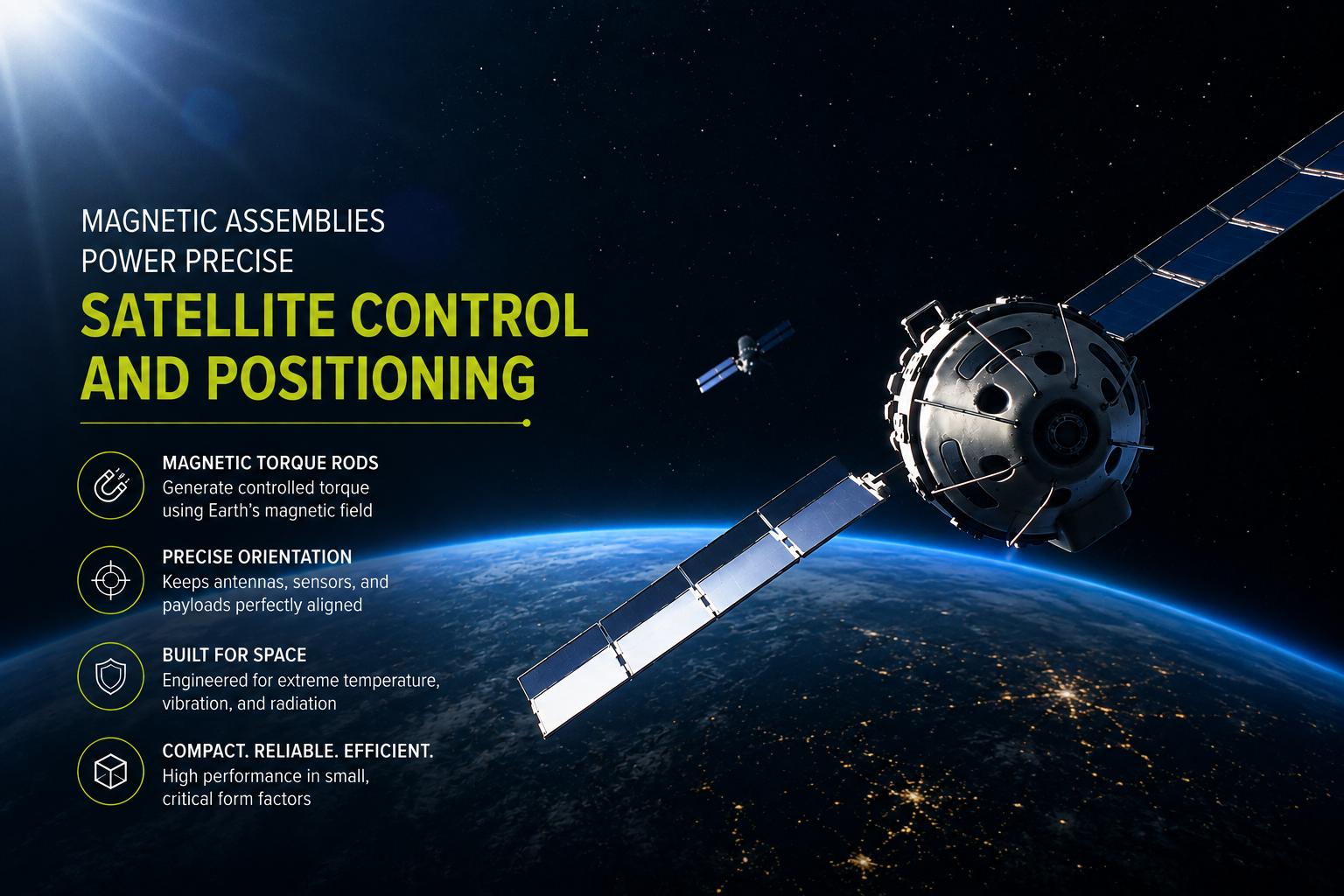
In orbit, direction matters. A satellite may need to keep an antenna pointed toward Earth, align a sensor with a precise target, orient solar arrays toward the Sun, or maintain a specific position for scientific observations. Accomplishing these tasks requires precise control over the satellite’s orientation, known as attitude.
Attitude determination and control systems (ADCS) use technologies such as reaction wheels, thrusters, magnetic torque rods, and electromagnetic actuators to manage this orientation. Among these technologies, magnetic systems provide a compact method of generating controlled torque without consuming propellant.
Using Earth’s Magnetic Field for Control 
Magnetic torque rods, also called magnetorquers, take advantage of a resource already present in low Earth orbit: Earth’s magnetic field.
A typical torque rod consists of an electrically conductive coil wound around a ferromagnetic core, although air-core designs are also used. When current flows through the coil, it generates a controlled magnetic dipole. The interaction between this magnetic moment and Earth’s local magnetic field produces torque on the spacecraft.
By adjusting the magnitude and direction of current supplied to torque rods positioned along different spacecraft axes, the ADCS can generate controlled rotational forces.
Torque rods are commonly used for detumbling, particularly after a satellite separates from its launch vehicle and enters orbit with an uncontrolled rotation. They can also assist with attitude stabilization and momentum unloading, or desaturation, of reaction wheels.
Because magnetorquers interact with Earth’s magnetic field, the amount and direction of available torque depend on the spacecraft’s position and orientation relative to that field. As a result, torque rods are often integrated with reaction wheels or other control technologies rather than used as the sole method of attitude control.
Magnetic Actuation Beyond Torque Rods
Magnetic technology can support additional positioning and motion-control functions within a spacecraft.
Permanent magnets may be incorporated into motors, actuators, encoders, and other electromechanical assemblies used for pointing, positioning, stabilization, or deployment. These systems can provide precise and repeatable motion while meeting the demanding size, mass, and power constraints associated with spacecraft design.
For small satellites and CubeSats in particular, efficient use of available space and electrical power can be critical. Magnetic assemblies can provide significant functionality within compact packages when the magnetic circuit, materials, and mechanical structure are optimized together.
Engineering Magnetic Assemblies for Space
Generating magnetic force or torque is only part of the engineering challenge. The assembly must maintain predictable performance throughout launch and operation.
Space-bound magnetic systems may encounter launch shock and vibration, vacuum conditions, radiation exposure, and repeated temperature cycling. Engineers must also consider dimensional tolerances, magnetic orientation, mechanical retention, coatings, adhesives, and potential demagnetization.
Magnetic material selection is especially important. Samarium cobalt (SmCo) can provide strong temperature stability and resistance to demagnetization, making it well suited for demanding thermal environments. Neodymium iron boron (NdFeB) can provide high magnetic energy density, which can be advantageous when reducing assembly size and mass is a priority. The appropriate material ultimately depends on the operating temperature, required magnetic output, available volume, and environmental conditions.
Precision From Launch Through Mission Life
For an attitude-control system to respond predictably, its magnetic components must behave predictably. Magnetic moment, field strength, orientation accuracy, thermal stability, dimensional tolerances, and magnetic uniformity can all influence system performance.
Simulation, magnetic circuit analysis, precision manufacturing, and magnetic characterization help engineers understand and control these variables before an assembly reaches orbit.
From detumbling after deployment to maintaining precise orientation throughout a mission, magnetic torque rods and actuators perform critical functions that can be easy to overlook. As satellite platforms become smaller and positioning requirements become more demanding, carefully engineered magnetic systems will continue helping spacecraft stay pointed in the right direction.