



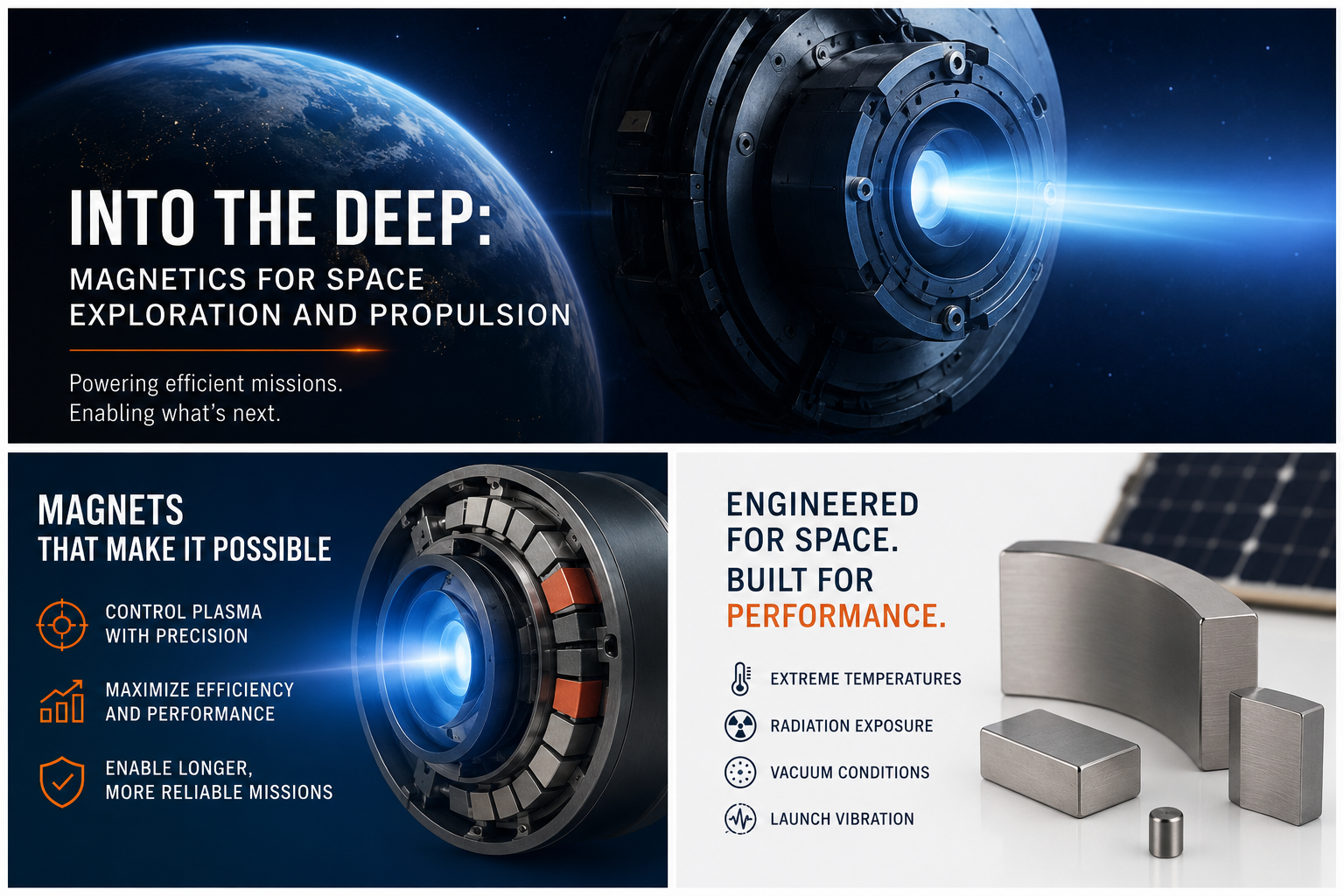
Into the Deep: Magnetics for Space Exploration and Propulsion
Into the Deep: Magnetics for Space Exploration and Propulsion
As satellites become more capable and space missions extend farther from Earth, propulsion technology continues to evolve. Traditional chemical propulsion remains essential for launch vehicles, but once in orbit, many spacecraft rely on electric propulsion systems to maximize efficiency, conserve propellant, and enable years of reliable operation.
At the heart of many of these systems are permanent magnets. In Hall-effect and ion thrusters, carefully engineered magnetic circuits help control plasma behavior, improve propulsion efficiency, and support the long operational lifetimes required for commercial, defense, and scientific missions.
 Hall-effect thrusters: Controlling plasma for efficient thrust
Hall-effect thrusters have become a preferred propulsion solution for satellite station keeping, orbit raising, and deep space exploration. These systems generate thrust by ionizing a propellant, typically xenon, and accelerating the resulting ions through an electric field.
Permanent magnets create the magnetic field that confines electrons within the discharge chamber while allowing heavier ions to accelerate and exit the thruster. This controlled interaction between electric and magnetic fields is what enables Hall thrusters to produce efficient, continuous thrust using significantly less propellant than conventional chemical systems.
The design of the magnetic circuit directly affects thruster performance. Optimized magnetic field distribution improves plasma stability, increases ionization efficiency, reduces power consumption, and minimizes erosion of internal components, all of which contribute to longer mission life.
Ion thrusters: Precision for long duration missions
Ion thrusters operate on a similar principle but use electrostatic grids to accelerate ions after they are generated within the discharge chamber. Permanent magnets help confine electrons, increasing the probability of collisions that ionize the propellant.
This efficient ionization process enables ion engines to achieve exceptionally high specific impulse, allowing spacecraft to operate for thousands of hours while consuming relatively small amounts of propellant. These capabilities make ion propulsion well suited for scientific exploration, planetary missions, and long duration satellite operations.
Reliable magnetic performance is essential because even small variations in magnetic field strength or geometry can affect propulsion efficiency and overall system performance.
Choosing magnetic materials for space
Space presents one of the harshest operating environments for magnetic components. Propulsion systems must withstand vacuum conditions, radiation exposure, launch vibration, and significant temperature extremes while maintaining consistent performance over many years.
For many electric propulsion applications, samarium cobalt magnets offer significant advantages. Their excellent thermal stability, strong resistance to demagnetization, and long term magnetic performance make them well suited for demanding aerospace environments. Material selection, however, should always be based on the specific operating conditions and mission requirements.
Engineering beyond the magnet
Successful propulsion systems depend on more than selecting the right magnetic material. Precision magnetic modeling, field mapping, tight manufacturing tolerances, and assembly integration all play important roles in achieving predictable performance.
Collaborating with magnetic engineers early in the design process helps optimize magnetic circuits, identify manufacturability challenges, and reduce costly redesigns later in development. This engineering partnership is particularly valuable as propulsion systems become smaller, lighter, and more powerful.
Enabling the next generation of exploration
The rapid growth of commercial satellite constellations, lunar exploration programs, and deep space missions is driving continued innovation in electric propulsion. As these systems become more advanced, the demand for precisely engineered magnetic assemblies will only increase.
From maintaining stable plasma to maximizing propulsion efficiency and mission life, permanent magnets remain a foundational technology behind modern electric propulsion. By combining advanced magnetic materials with precision engineering, manufacturers can help spacecraft travel farther, operate longer, and perform more reliably in the challenging environment of space.